Oral stories and their transmission
The Drover's WifeOral stories and their transmission are a living practice through which the novel connects cultural knowledge to family memory and future generations. Stories are not merely accounts of the past: they carry responsibility, teach conduct, and become embodied in dance, performance, and repeated telling. Their forms change as they move between people, but the act of passing them on keeps both personal histories and communal knowledge in circulation.
Adoption, responsibility, and inherited stories
Yadaka’s understanding of storytelling is shaped by his adoptive mother, Ginny May. After he finds refuge among a clan gathered to celebrate the bogong moth, the elders agree that he may stay and be adopted by her. She calls him her son, and he is grateful for the relationship. He later learns why she chose him: she has a story she holds dear but is forbidden to share within her clan, a tale associated with treachery, broken lore, and forbidden love. Adoption gives Ginny May a way to entrust it to him. Yadaka becomes its chosen keeper, responsible for ensuring that it remains alive and may one day have consequences beyond the telling itself.
That inheritance does not arrive as a settled, orderly account. When memories of Ginny May’s story return to Yadaka, they come in fragments rather than chronological sequence. He must take time to put them together again and considers asking the ancestors for guidance; if Ginny May has died, he hopes she may come to him in dreams. The broken order of recollection makes transmission a task of interpretation as well as preservation: the story survives, but its new keeper must work to recover its shape.
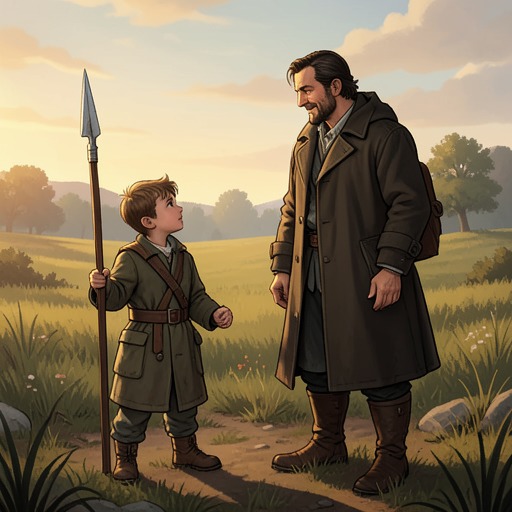
Yadaka also describes storytelling as part of Danny’s responsibilities as he grows toward manhood. Caring for his mother, siblings, and household is only one part of that duty. Danny must also learn the stories of the land, sky, and animals, and retell them to his own sons. Yadaka connects that learning to walking the mountain to a sacred place and to the completion of Danny’s first proper kill. Knowledge, in this account, belongs to a broader practice of responsibility: it is learned over time and is meant to be carried forward, not kept as private information.
Stories that make difficult experience tellable
The novel also shows storytelling giving form to experiences that have remained private. Years later, Daniel Johnson sits alone on the verandah of a renovated homestead with a sixteen-year-old notebook containing sketches, poems, and memories. Its pages preserve what he learned during the four years he spent with his siblings among the people whose knowledge was ancient and could only be shared with them to a limited extent. Daniel has felt compelled to record those experiences, while recognizing that time and society have stood against their transmission.
The notebook is also a record of deliberate silence. Daniel remembers that Louisa Clintoff taught him to write poetry and suggested that he use a poem to ease pain and loss, without having to show it to anyone. The painful events he writes about have not previously been shared, even with his siblings. He understands protecting them as his continuing responsibility, though they are now grown. Writing therefore gives private memory a form without immediately making it public; the notebook holds what family loyalty has kept unspoken, while preserving the possibility that it may later be read or retold.
This tension between silence and telling is present in Danny’s memory of violence within the household. When Nate asks what Danny might have heard on a particular night, the narrative enters the boy’s recollection: awake and frightened, he hears sounds from outside and sees his father assaulting his mother. He remembers being unable to intervene after an earlier attempt to help had ended with his father throwing him aside. The memory is a direct witnessing, but Danny initially gives Nate only the dismissive answer that it was the usual thing. The gap between what he remembers and what he can say shows that transmission is not automatic: a past event may remain withheld even when its witness is asked to speak.
Yadaka offers Molly a different account of why telling matters. When she questions why he has shared his own life story, he answers, "A life’s story untold is a life not lived, missus." Later, when Molly rejects his account of her mother, Waraganj, Yadaka insists that he has no malice in passing it on: he received the story from Ginny May as part of lore that must be shared so people can live into the future. He tells Molly that her mother lived, and that her life mattered. In this exchange, transmission is difficult and potentially unwelcome, but it is also an act of recognition: a story can restore a history that others have obscured or reduced to a racial label.
Gesture, dance, and the changing form of a story
Knowledge passes through bodies as well as words. When Danny describes the wild grey bullock that threatened his siblings, Yadaka joins in by imitating the animal in an Aboriginal dance. As Danny narrates the encounter, Yadaka follows his movements, flicking dirt with his feet. Molly is startled by the sudden action, while Danny becomes more animated as Yadaka enters his account. The event is no longer told by Danny alone: imitation turns his memory into a shared performance, allowing another person to participate in its telling.
That use of movement resonates with Danny’s earlier memories of Aboriginal ceremonies. As a child, he and Molly once came upon a gathering of men and boys painted with distinct designs made from ochre and water. Molly understood that the ceremony was not meant for them to witness, and they left. Later, they heard singing and stamping, followed in the days afterward by women’s cries. The episode presents cultural practice as something whose meaning is not freely available to every observer. It also contrasts with the later exchange between Danny and Yadaka, where a story is shared through movement in the intimacy of a teaching relationship.
The bullock account eventually enters communal practice. Danny tells the story to the Ngarigo, who incorporate it into an existing tradition of mimicry and dance, developing it through song and movement. The siblings are proud that the clan honors Molly’s bravery and acknowledges her plight, bringing her into the family clan through the story. The performance becomes a way for them to remember their mother and for the clan to share in her history. The account changes in scale and ownership: what began as Danny’s experience becomes a story that the community can perform and preserve.
Family retelling and continuity
In the later family scene, Danny’s children inherit the bullock story not as distant history but as an activity they already know how to perform. They stage a simplified version, with one child playing the gun and Danny taking up Yadaka’s old role by mimicking the bullock. The reenactment has no ceremonial paint, singing, or traditional instruments, yet the children’s play keeps the remembered event present in the household. Their performance concludes with the bullock’s defeat and embraces for Danny, turning a story of danger and their grandmother’s bravery into shared family play.
The scene places multiple modes of transmission side by side. Each evening the children hear stories: sometimes their father reads or tells this very history, sometimes their mother tells Dreaming stories about the land and its origins, and sometimes the children act out the Bullock Story themselves. Danny’s account thus exists in writing, spoken narration, and play, while other kinds of knowledge continue through their mother’s stories. Different tellers and forms coexist without being interchangeable; the children’s reenactment belongs to their family’s everyday life, while the story’s earlier adoption by the Ngarigo gave it a place in communal practice.
Danny explicitly understands the story as something he has lived, told, and will tell again. He intends to pass it down as a story of survival. Its movement from a remembered encounter, to Yadaka’s embodied imitation, to Ngarigo performance, and finally to the children’s play demonstrates how repetition can preserve a history while adapting its form and audience. The family’s retelling keeps Molly’s courage present for descendants who did not witness the original event, and makes cultural continuity an ongoing practice rather than a recovered past.